Home > Access Arrangements and the DSA

Access Arrangements and the Disabled Students' Allowance


What are Access Arrangements?

Access Arrangements are changes made to the conditions under which candidates sit exams if there is evidence that they have specific difficulties.

Schools and colleges are required to provide evidence of below average performance on set criteria if special arrangements are to be made.

The National Assessment Agency (NAA) and Joint Council for Qualifications (JCQ) are responsible for setting and monitoring the regulations.


Which tests from Pearson Assessment are suitable?|

What are the 2011 Regulations?|

How do I meet the requirements?|

How do I convert scores?|

Where can I find out more about the testing regulations, and courses?|

Guide to Access Arrangements and Disabled Students' Allowance|


--------------------------------------------------------------------------------

What are the 2011 Regulations?

Only the regulations linked to tests for specific learning difficulties are included here, for full information on access arrangements, consult the relevant documents referenced below.


National Curriculum Assessments
Key Stage 2 (years 3-6)

For up to 25% additional time:
Pupils are required to meet at least 3 criteria in Section A (below) or one criterion in Section B (Section B deals with EAL and physical, medical or sensory conditions and are not described here).

Section A  

  1. A reading score in the below average range for the pupil’s age (using a test of comprehension, single word reading or reading rate (accuracy + speed). (a standardised score of less than 85).
  2. Pupils increase their reading comprehension age by nine months or more when allowed 25% additional time to complete a timed reading test, or there is other evidence of slow reading speed.
  3. A free writing speed of 10 words or fewer per minute (key stage 2) or 15 words or fewer per minute (key stage 3).(A recognised test of writing speed should be carried out or a pupil should be asked to write for at least 10/15 minutes and the number of words written per minute calculated).
  4. A processing speed that is in the low average or below average range for the pupil’s age. (a standardised score of less than 90).
  5. Significant discrepancy between cognitive ability and performance shown by: At least average verbal reasoning, non-verbal reasoning or quantitative scores (90 or above), alongside below average literacy scores (below 85), or a 20 point or more difference between verbal and performance IQ.

General Qualifications

Below average performance in the areas listed below which are relevant for a particular candidate. (Below average is defined by the JCQ as a standardised score of below 85).

Reading

  • Reading Accuracy
  • The candidate’s untimed single word reading accuracy is in the below average range for his/her age.
  • Comprehension/speed of reading
  • The candidate reads and/or comprehends continuous text at a speed/level which is below average for his/her age. (The reading speed score may be given as a standardised score or words per minute score).
  • This is useful for candidates who score within normal limits on 1. above, but have a history of reading difficulties and read slowly or have to re-read a text several times to access the meaning.

Writing  

  • Accuracy and legibility
  • The candidate’s spelling accuracy is in the below average range.
  • Standardised results, plus the number of words unrecognisable as the target word as a percentage of the whole assessment is specified.
  • Speed of writing
  • The candidate expresses him/herself in written form more slowly than average.
  • The free writing speed (Standard Score or WPM); percentage of indecipherable words; free writing speed when dictated to scribe/word processed; and the quality of language is specified or commented on.


Other relevant information

Where extra time may be required despite otherwise normal levels of literacy, areas such as phonological processing, cognitive deficits in for example working memory, and sequencing problems may be reported in this section.

We kindly acknowledge the QCA and the JCQ for the information presented in this section. This has been extracted from the documents referenced below| following their permission guidelines and is copyrighted to them.


How do I meet the requirements?

Standard scores must be provided as evidence of below average performance.

A standard score is converted from the frequency distribution of raw scores for any one age group. This allows comparison of an individual’s performance against their age group.

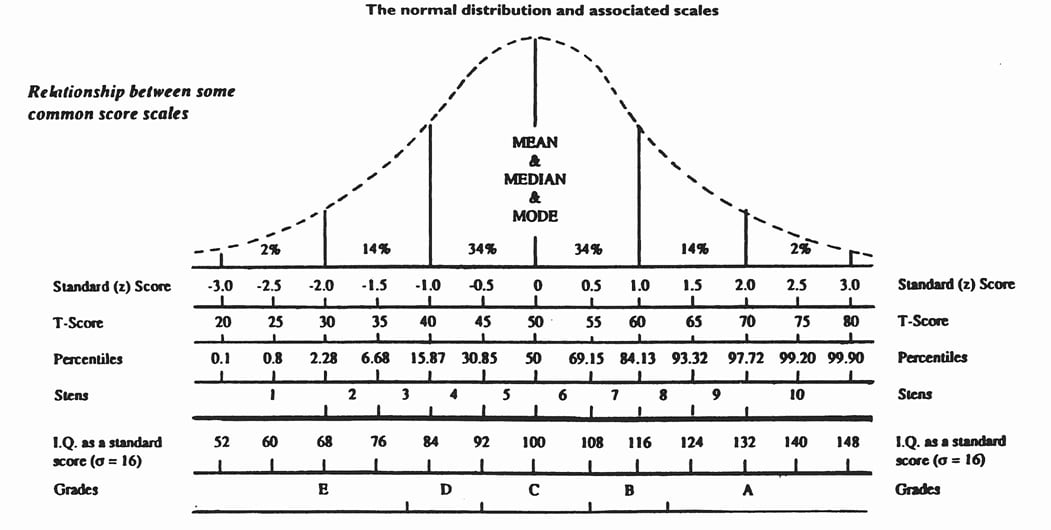
Standard scores have a mean of 100 and a standard deviation of 15. The governing bodies therefore consider a standard score of below 85 indicative of below average performance.

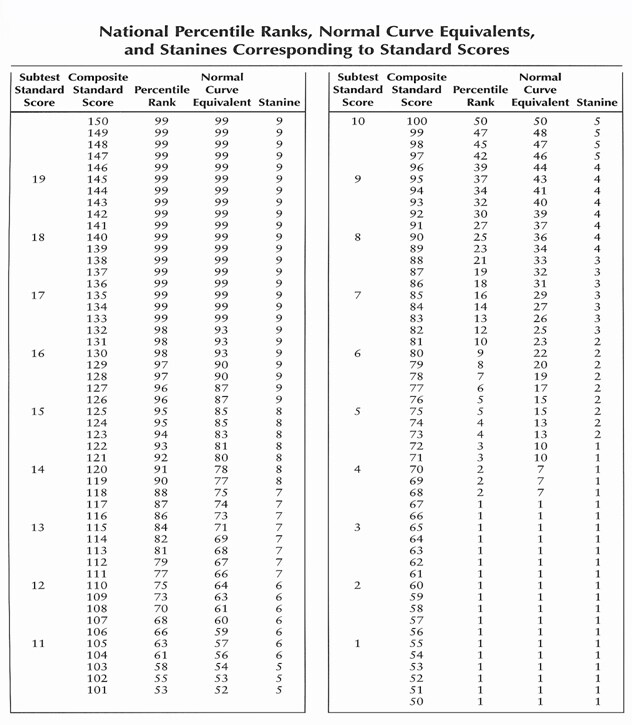
Standard scores can sometimes be presented with a mean of 10 and a standard deviation of 3. A standard score of below 7 is equivalent to achieving a score of below 85 on a composite standard score.

The table and figure below show the relationship between standard scores and other common score scales.

Click for National Percentile Ranks, Normal Curve Equivalents, and Stanines corresponding to Standard Scores| (jpg, 205KB)

Click for Normal Distribution and Associated Scales| (jpg, 201KB)

These scores are obtained by using standardised assessments. Which tests from Pearson Assessment are suitable?


How do I convert scores?

The table and figure below show the relationship between standard scores and other common score scales:

Click for National Percentile Ranks, Normal Curve Equivalents, and Stanines corresponding to Standard Scores| (jpg, 205KB)

Click for Normal Distribution and Associated Scales| (jpg, 201KB)

These scores are obtained by using standardised assessments. Which tests from Pearson Assessment are suitable?  


Where can I find out more?

Regulations

National Curriculum Assessments
Assessment and Reporting Arrangements Key Stage 2 (980KB, PDF). Qualifications and Curriculum Authority (QCA), 2008. ISBN 978 1 84721 646 5

General Qualifications
Access Arrangements, Reasonable Adjustments and Special Consideration|. Joint Council for Qualifications (JCQ), 2008.

The latest regulations on the JCQ official website| (PDF Download)(www.jcq.org.uk|).

PATOSS Greenwold, L. (Ed), (2007)
Dyslexia: Assessing the need for Access Arrangements during Examinations. Third Edition. Worcs. Available from www.patoss-dyslexia.org| 


Courses

Communicate-ed is a company specialising in the training of education professionals who work in the area of special needs. They run a number of courses in the implementation of access arrangements for General Qualifications and National Curriculum Tests.

Visit www.communicate-ed.org.uk| to find out more about up-coming courses in your area.


Links

Qualifications and Curriculum Authority (QCA)|

Joint Council for Qualifications (JCQ)|


Guide to Access Arrangements

We have produced a guide to Access Arrangements and the Disabled Students' Allowance.

It is available as a pdf download here|.

Or, if you would like a hard copy, please email marketing@psychcorp.co.uk|.


Cogmed Online Seminars|  

Attend a free online seminar and learn all about Cogmed Working Memory Training.